The Illusion of Rarity
When you hear the word diamond, what comes to mind?
Probably love, eternity, commitment. Maybe even status and wealth.
But here’s the twist: diamonds are not the rarest gemstones on Earth. Rubies, emeralds, and sapphires can be harder to find. Geologically speaking, there are plenty of diamonds.
So why do we treat them as if they’re priceless treasures?
The answer lies in one of the most brilliant (and controversial) marketing strategies in history — De Beers.
A Problem in Plain Sight
In the early 1900s, De Beers had a business challenge:
-Diamond mines were producing more stones than the market demanded.
-Oversupply meant falling prices.
-Without a fix, diamonds risked becoming just another shiny stone.
Most companies would cut prices. De Beers did the opposite. They created an idea.
“A Diamond is Forever”
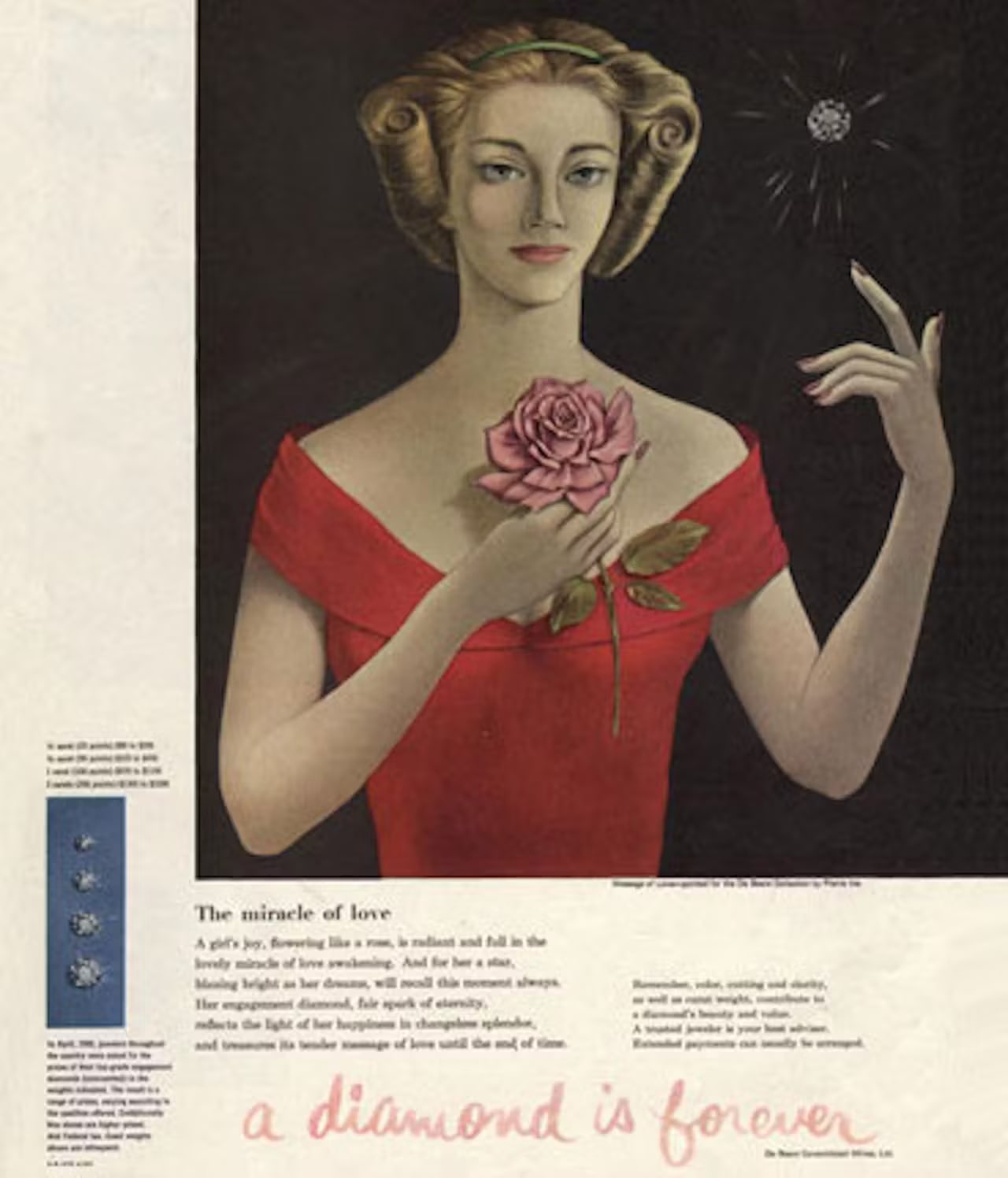
In 1947, their advertising agency coined a slogan: “A Diamond is Forever.”
This wasn’t just a campaign. It was a cultural movement.
-Diamonds were positioned as the ultimate proof of eternal love.
-Engagements without diamonds? Suddenly unthinkable.
-Celebrities and ordinary couples alike were shown sealing their futures with these stones.
By attaching emotion to the product, De Beers turned a geological commodity into a social necessity.“A Diamond is Forever.” This phrase didn’t just sell product—it sold a promise, a feeling. It reframed diamonds as the ultimate symbol of eternal love . Over time, it became recognized as the most memorable slogan of the 20th century.The emotional appeal resonated deeply. As one historical reader recalls: it asked, “What better way to symbolize your everlasting love than with a stone that never wears out?”
Engineering Desire with Emotion
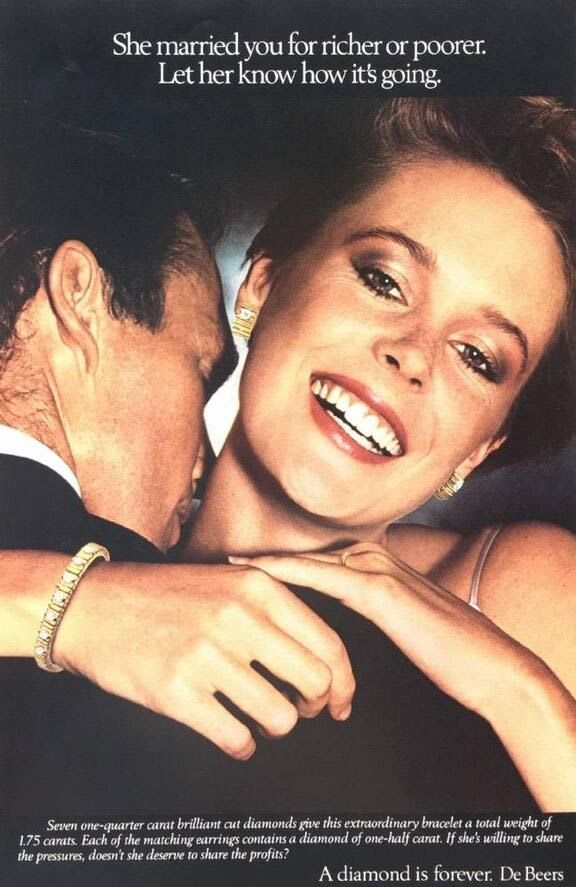
De Beers’ strategy wasn’t limited to slogans:
-Storytelling & celebrity placement: Ads featured socialites, movie stars, and romantic scenes—not product shots. This made consumers imagine their own love stories with diamonds as the centerpiece .
-The “4 Cs” education: They taught consumers about Cut, Carat, Color, and Clarity—educating while guiding them towards what constituted a “perfect” diamond .
-Persistent consistency: While most ad campaigns rotate slogans, “A Diamond is Forever” has endured for nearly eight decades
Scarcity by Design
Behind the scenes, De Beers controlled almost 90% of the global diamond trade.
-They stockpiled stones and released them slowly.
-By creating artificial scarcity, they kept prices high.
-Scarcity + emotional demand = luxury positioning.
It wasn’t just selling; it was engineering perception.
The Ripple Effect
Fast forward to today:
-“A Diamond is Forever” remains one of the longest-running slogans in advertising history.
-Proposing without a diamond still feels incomplete to many.
-Billions in value have been created out of cultural expectation, not geological rarity.
All because of a story.
Lessons for Marketers
So, what can we learn from De Beers’ playbook?
- Sell emotion, not just products. A diamond wasn’t marketed as carbon — it was marketed as eternal love.
- Create rituals, not transactions. They built a social norm around proposals.
- Engineer scarcity. Real or perceived, scarcity drives desire.
- Make it stick. A powerful slogan or story can last for generations.
The Double-Edged Sword
Was it brilliant? Absolutely.
Was it manipulative? Without question.
But that’s the paradox of marketing: the power to shape culture can inspire or exploit. De Beers’ diamonds are a reminder of both the brilliance and responsibility of our craft.
💡 Question for readers: What other products do you think owe their value more to marketing than to actual scarcity?


